Back to Research Library
2 Studies

Ligaments & Tendons

The ACL is crucial for knee stability and is frequently damaged during athletic activities. Our research explores alternatives to autograft reconstruction—including the first human clinical trial using "humanized" porcine tissue.

20 Years
Longest Follow-up
30+
Years Developing Technique
50%
Xenograft Study Success
250,000
ACL Injuries/Year (US)

About This Research Area

The current standard for ACL reconstruction involves grafting either autologous (patient's own) or allogeneic (cadaveric) tendons. Both methods have disadvantages: autograft harvest creates a second surgical site with increased pain and morbidity, while many allogeneic tendons come from elderly individuals with reduced biomechanical capacity.

Our research has explored two alternatives: using stronger allograft quadriceps tendon with a reproducible 3-incision technique, and—more experimentally—"humanizing" porcine tissue through enzymatic treatment to create unlimited supply of strong, young tissue.

Published Studies

2023
Prospective Case Series n=10 20 years follow-up

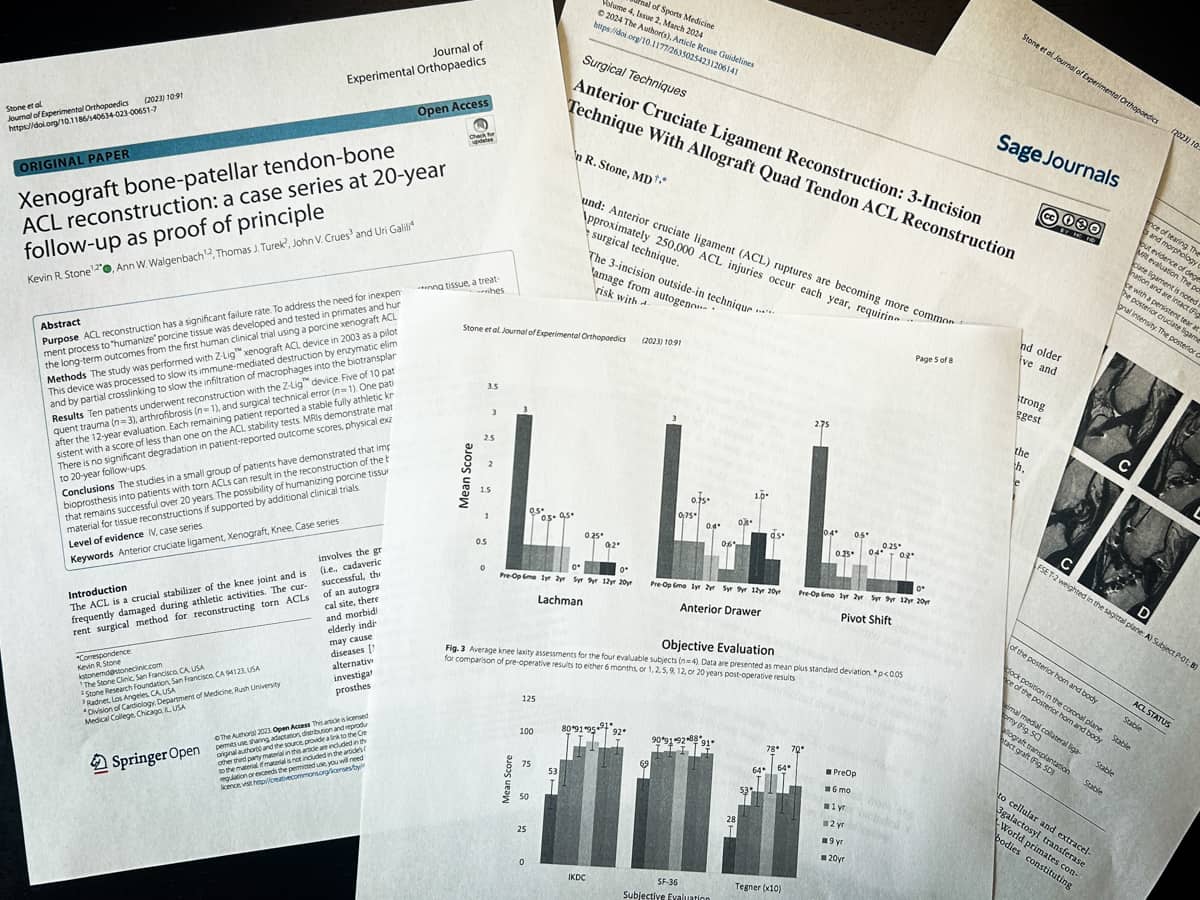
Xenograft Bone-Patellar Tendon-Bone ACL Reconstruction: A Case Series at 20-Year Follow-up as Proof of Principle

Kevin R. Stone, Ann W. Walgenbach, Thomas J. Turek, John V. Crues, Uri Galili

The studies in a small group of patients have demonstrated that implantation of porcine ligament bioprosthesis into patients with torn ACLs can result in the reconstruction of the bioprosthesis into autologous ACL that remains successful over 20 years. The possibility of humanizing porcine tissue opens the door to unlimited clinical material for tissue reconstructions.

Key Finding: First demonstration that "humanized" porcine ligament can remodel into functional autologous ACL over 20 years.

Journal of Experimental Orthopaedics View Publication
2024
Surgical Technique

Anterior Cruciate Ligament Reconstruction: 3-Incision Technique With Allograft Quad Tendon ACL Reconstruction

Kevin R. Stone

The 3-incision technique with allograft quadriceps tendon for ACL reconstruction is a reproducible surgical technique that avoids harvest from the patient's own body. Quadriceps tendon is significantly thicker and stronger than other allograft tissues available.

Key Finding: Reproducible allograft technique using quadriceps tendon—avoiding autograft harvest damage.

Video Journal of Sports Medicine View Publication

The Xenograft Breakthrough

The 2023 xenograft study represents a proof of principle for one of the most ambitious goals in orthopaedic tissue engineering: creating unlimited, strong, young tissue from animal sources.

The processing technique eliminates α-gal epitopes (which trigger immune rejection) and uses partial glutaraldehyde crosslinking to slow macrophage infiltration. This allows the porcine tissue to gradually remodel into autologous human tissue.

While 5 of 10 patients experienced failure (3 from subsequent trauma, 1 from arthrofibrosis, 1 from technical error), the remaining patients demonstrated stable, fully athletic knees at 20 years with MRIs showing mature remodeling of the device.

If supported by additional clinical trials, this approach could eliminate the tissue supply limitations that currently constrain orthopaedic reconstruction.

Surgical Technique Videos

Surgical Technique

ACL Reconstruction: Three-Portal Technique

Our ACL reconstruction involves a three-portal technique using donor tendon after arthroscopic treatment of associated injuries. Notch plasty is performed only if necessary for visualization.

Surgical Technique

ACL Primary Repair

When torn in a way that permits primary repair, sutures are placed in the ligament and secured with anchors. Growth factors and stem cells speed healing at the repair site.

Complex Reconstruction

Posterolateral Corner Reconstruction

Anatomic reconstruction using anterior tibialis tendon allograft, passed through the fibular head and secured to the femur to eliminate posterolateral instability.

"The anterior cruciate ligament is the key stabilizer of the knee going from the back of the femur to the front of the tibia. It is ruptured commonly in sports with twisting motions. Fortunately, the ACL can be reconstructed. Our preference is to use a donor tendon which has been treated to sterilize the tissue and then used to rebuild the new anterior cruciate ligament."

— Dr. Kevin R. Stone