Back to Research Library
4 Studies

Articular Cartilage

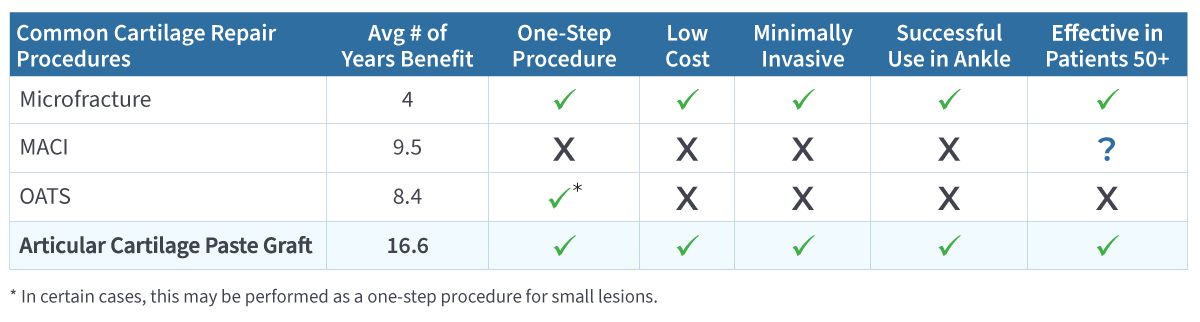
Articular cartilage covers the bones in joints and contributes to smooth, pain-free motion. Our research focuses on the paste graft technique—a single-stage, minimally invasive procedure for restoring damaged cartilage surfaces.

275+
Total Patients Studied
23 Years
Longest Follow-up
19.1 Years
Median Benefit Time
85.6%
Success Rate

About This Research Area

Damaged articular cartilage has a limited ability to heal on its own. Damage can lead to pain, swelling, and loss of motion. The articular cartilage paste graft was developed in 1991 by Dr. Kevin R. Stone as a cost-effective, minimally invasive technique for cartilage repair indicated for both widespread and focal cartilage damage.

The technique uses autologous cartilage and bone harvested from the intercondylar notch, morselized into a paste, and impacted into the prepared defect. Unlike other techniques, paste grafting is entirely arthroscopic, uses autologous tissue, and is performed in a single session.

Published Studies

2020
Basic Science / In Vitro n=16

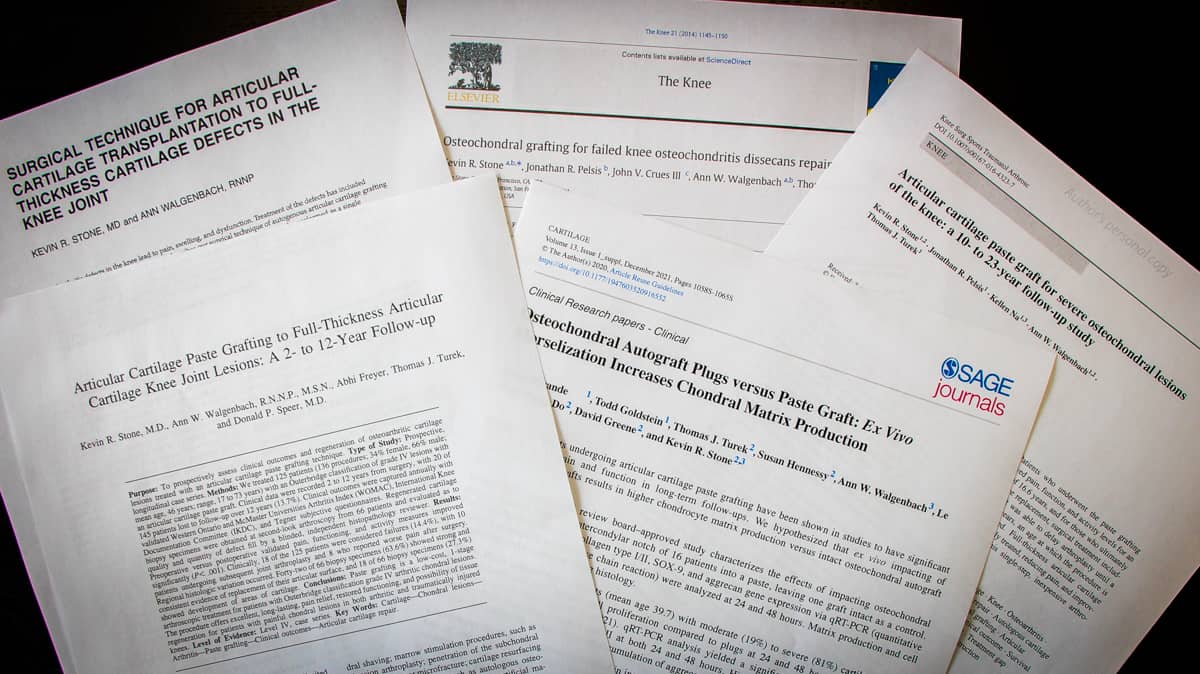
Osteochondral Autograft Plugs versus Paste Graft: Ex Vivo Morselization Increases Chondral Matrix Production

Daniel Grande, Todd Goldstein, Thomas J. Turek, Susan Hennessy, Ann W. Walgenbach, Le Hanh Dung Do, David Greene, Kevin R. Stone

Paste graft preparation resulted in increased mobility of chondrocytes by matrix disruption without loss of cell viability. The impaction procedure stimulated chondrocyte proliferation resulting in a cellular response to reestablish native extracellular matrix. Analysis of gene expression supports a regenerative process of cartilage tissue formation.

Key Finding: Morselization increases chondrocyte proliferation 34-80%; contradicts long-held beliefs that impaction trauma leads to cell death.

2016
Prospective Longitudinal n=74 10-23 years follow-up

Articular Cartilage Paste Graft for Severe Osteochondral Lesions of the Knee: A 10- to 23-Year Follow-up Study

Kevin R. Stone, Jonathan R. Pelsis, Kellen Na, Ann W. Walgenbach, Thomas J. Turek

Patients who underwent paste grafting reported improved pain, function, and activity levels for an expected mean of 16.6 years. For those who ultimately progressed to knee replacement, surgical treatment including the paste graft was able to delay arthroplasty until a mean age of 60.2 years.

Key Finding: Median benefit time of 19.1 years; 90% reported good-excellent pain relief; delayed arthroplasty to mean age 60.2 years.

Knee Surgery, Sports Traumatology, Arthroscopy View Publication
2006
Prospective Longitudinal with Histology n=125 2-12 years follow-up

Articular Cartilage Paste Grafting to Full-Thickness Articular Cartilage Knee Joint Lesions: A 2- to 12-Year Follow-up

Kevin R. Stone, Ann W. Walgenbach, Abhi Freyer, Thomas J. Turek, Donald P. Speer

Paste grafting is a low-cost, 1-stage arthroscopic treatment for patients with Outerbridge classification grade IV arthritic chondral lesions. The procedure offers excellent, long-lasting pain relief, restored functioning, and possibility of tissue regeneration.

Key Finding: 85.6% success rate; 63.6% of biopsies showed strong cartilage regeneration evidence.

Arthroscopy View Publication
1997
Surgical Technique n=60

Surgical Technique for Articular Cartilage Transplantation to Full-Thickness Cartilage Defects in the Knee Joint

Kevin R. Stone, Ann Walgenbach

The mixture of articular cartilage and cancellous bone appears to provide a supportive matrix for cartilage formation. Pain relief is excellent if careful surgical technique and defined rehabilitation program is followed.

Key Finding: Original description of the paste graft surgical technique combining autologous cartilage and bone.

Operative Techniques in Orthopaedics

Clinical Significance

Our long-term outcome data demonstrates that paste grafting provides durable pain relief and functional improvement for patients with severe cartilage damage—a population often told their only option is joint replacement.

The 2016 study showing a median benefit time of 19.1 years represents one of the longest follow-ups in cartilage repair literature. For patients who ultimately required arthroplasty, the procedure successfully delayed it to a mean age of 60.2 years—when joint replacement outcomes are typically most favorable.

The 2020 basic science study provided mechanistic insight: contrary to the long-held belief that impaction trauma kills chondrocytes, morselization actually stimulates cell proliferation and matrix production, supporting the clinical observations of cartilage regeneration.

Educational Videos

Interview

Articular Cartilage Paste Graft Technique

Dr. Stone explains the paste grafting technique developed in 1991. The procedure involves harvesting articular cartilage and underlying bone from the intercondylar notch, forming it into a paste containing marrow stem cells, and packing it onto prepared arthritic surfaces to regrow repair tissue. Published 2-12 year data on 125 patients demonstrates patients returning to full impact sports with pain relief lasting 17+ years.

Surgical Technique

Biologic Joint Replacement: Paste Grafting

Surgical demonstration of paste grafting for a medial femoral condylar lesion in a cyclist. The lesion is prepared to create a bloody bed, graft is harvested from the intercondylar notch, formed into a paste, and impacted into the lesion. The technique does not completely fill the lesion as these typically hypertrophy during healing.

"When the joint becomes arthritic, the articular cartilage wears down to the surface of the bone. We make small holes to release marrow cells, then take articular cartilage and underlying bone from where it's not needed, smash it into a paste containing marrow stem cells, and pack it back onto the articular surface. This articular cartilage paste grafting, especially when combined with a meniscus replacement, provides what we call a biologic joint replacement rather than an artificial joint replacement."

— Dr. Kevin R. Stone